Wednesday, May 9, 2012

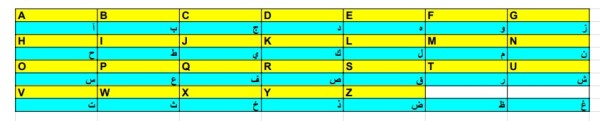
Latin-Arabic Alphabetical Order Equivalence Chart


After years of being away due to motherhood-induced upheavals and globetrotting, I am finally back, more intent on sharing my translation-relevant insights, experiences and eventual tips.

Indeed, the other day as I was using an older version of MS Word, I realized that it only included in its bullet points numbering lists the conventional alphabetical order in Arabic (أ ب ث د ...) which is not useful  because the order to use in such collation processes is the phoenician-inspired semitic Abjad configuration (that is آبجد هوز حطي كلمن سعفص قرشت ثخذ ضغظ).
I encountered many situations where such an order was not included in the MS Word or Openoffice version I happened to be using, or even in situations of interpretation, and had therefore to write down an improvised chart listing the Latin alphabet with its equivalent Abjad letters on post-it notes, that were later lost and had to be redone whenever the same situation reoccurred.

So I had the idea of making a downloadable spreadsheet of such a chart that can be saved either in its soft or printed format. And of course I thought to share it with any eventual colleague out there. So you only have to click on the link, and download it from the File Menu of Google docs or print it out directly.
Hope many will find this useful.

Friday, November 28, 2008

Lebanon's Biblical Glory at the Heart of Rome


A linguist by profession, a Lebanese by birth and an expat by choice/destiny.  These are the factors that explain, I suppose, why I am an assiduous seeker of Lebanon's subtle cultural fingerprints around the world… inside words. 

Yes, words! 

Words say it all you know! Etymology is the key to hidden valuable secrets enclosed within words. 

Historical truths and glorious pasts lie under a thin layer of the dust of time, waiting to be revealed by a sharp eye and a keen sense of curiosity. 

Questioning the names of places, of persons, of things, always reveals their origin and links them to dimensions unknown to us. 

As far as Lebanon is concerned, everywhere I looked, when abroad, I almost always found some connection, some link, that referred to our Lebanese heritage.

In this very instance, I happened to be strolling in the narrow streets of Rome by night to burn some of the calories gulped in sometime before at a restaurant serving exquisite Roman cuisine in the Testaccio area.  As I crossed Via Portico d'Ottavia, I looked up inadvertently and something caught my eye. A word engraved on a small dome in the middle of the street. A word that said: "Libani"!

Libani in Latin could only mean one thing, one name, one place: LEBANON. My homeland.

I went closer and there it was:  a small cupola-roofed sanctuary with one sentence engraved on it: "GLORIA LIBANI DATA EST EL, DECORUM CARMELI ET SARON". 

Even though I have never studied Latin, my brain cells scurried to work out  connections between scattered pieces of knowledge stored in there for years… A mental-mnemonic process at the end of which I was finally able to utter the translation: The glory of Lebanon will be given to it, the majesty of Carmel and Sharon. Isaiah 35:2.

I knew it was a bible verse praising the beauty of Lebanon.

I knew that "Gloria Libani" is the title preceding the names of the Patriarchs of the Maronite Church (check the link).

But I did not know the reason it was there. 

I took the pictures (figuring here above) and hurried back to my hotel room, turned on my laptop, activated the Wi-Fi connection and typed in some keywords on my Google browser. And there I found it. An article in Italian explaining it all.

That sanctuary was a temple dedicated to the Virgin Mary. According to the exact wording of the article it was "dedicated to the Lady of the Carmel, otherwise known as the Lady of Mount Lebanon"!

For the readers that are not well-versed in geopolitics, in modern times the Mount Carmel (Garden of God) and the Mount Lebanon are each located now on two hostile territories. 

Strange how history changes transforming in the process the division of lands and ultimately ideas and perceptions.

The article also mentioned that this sanctuary known in Italian as Il Tempietto del Carmelo (The little temple of the Carmel) was built by a family of grocers in 1759 to shelter a picture of the Virgin Mary placed upon an altar. 

Due to negligence and subsequent degradation, both the picture and the supporting altar were lost, but the structure remained.

Fortunately, in 2004 restoration works were initiated at the cost of 97.000 Euros, and finally the cupola and the engraved inscription crowning it were restored.

Being located at the entrance of Rome's Ghetto, locals also regard it as a symbol of peace vis-à-vis the inhabitants. But that's another issue. 

In the period when I made this discovery, Lebanon's name in the media was particularly associated with all negative things imaginable. 

Finding its name unexpectedly, glowing by night in all its glory in the heart of Rome and on top of a Marian sanctuary, within a sentence paying homage to its biblical splendour, was not only refreshing but also a witness to its beautiful and spiritually rich past, that for sure will make its way back again to the collective consciousness of humanity, against all odds. 


Tuesday, April 8, 2008

The Pyrgi Tablets: An Ancient Translation into Phoenician!


Probably not many of you have heard of three ancient engraved golden plaques known as the Pyrgi Tablets.
This unusual find was excavated in 1964, in what is nowadays Santa Severa in Italy, a port of the ancient Etruscan town of Caere (or modern-day Cerveteri). These tablets were made to record the dedication of a temple to the Phoenician goddess of fertility, Ishtar (also known as Astarté, Ashtarout, and Ashtoreth).
What makes those tablets special is the fact that they are bilingual: the original Etruscan text marking the occasion was actually translated into Punic/Phoenician, which has enabled researchers to use their knowledge of the Semitic Phoenician language to read and understand the otherwise undecipherable Etruscan. Etruscan is still one of the most mysterious world languages as it cannot be grouped within the Indo-European languages, despite the fact that its speakers were European-based.
Moreover, these tablets provide evidence of the spread of the Phoenician/Punic cultural influence in the Western Mediterranean in pre-Roman eras, and show just how revered were the Phoenician deities in that part of the world. The battle of Alalia where the allied Etruscan-Punic (Phoenician) fleet defeated the Greek ships, is one of the clear indicators of the bonds between those two ancient Mediterranean peoples.
Back to the Pyrgi Tablets, the other funny thing, according to Charles Krahmalkov, a professor of ancient Near Eastern languages and the author of a book on Phoenician-Punic grammar, is that the translator of the tablets was probably an Etruscan whose Phoenician language was not very fluent, since he/she was translating literally from Etruscan!
I have copied and pasted an English translation found on the Internet of the Phoenician text.
To the speakers of Arabic among you, I have transliterated into Arabic letters some of the Phoenician words engraved on the tablets. You will notice that these words are almost identical to certain Arabic words used in our modern times.
Please note that the Phoenician script did not use vowels, so one should guess how certain words are pronounced.
L-rbt l-ʕštrt.
To the lady Ashtaret.للربّة- عشترت
ʔr qdš ʕz, ʕš pʕl, w-ʔš ytn Tbryʔ Wlnš mlk ʕl Kyšryʔ.
This is the holy place, which was made, and which was donated by Tiberius Velianas who reigns over the Caerites.
قدوش/قديش (مقدس) فعل (صنع) ويعطن (أعطي - قدّم) ملك
B-yr zb Šmš, b-mtnʔ b-bt, wbn tw.
During the month of the sacrifice to the Sun, as a gift in the temple, he built an aedicula.
ذبح - شمش (شمس ) معطنة (عطية - هبة) بيت - وبنى
K-ʕštrt ʔrš b-dy l-mlky šnt šlš, b-yr Krr, b-ym qbr ʔlm
For Ishtar raised him with her hand to reign for three years in the month of Churvar, in the day of the burying of the divinity.
بديا (بيدها) لملكي (ليملك) شنات شلاش(سنوات ثلاث) - يوم - قبر - إيليم/عاليم؟ (الآلهة))

W-šnt lmʔš ʔlm b-bty šnt km kkbm ʕl.
And the years of the statue of the divinity in the temple [shall be] as many years as the stars above.
وشنوت (سنوات) إيليم (جمع إيل.؟ آلهة) بالبيت (الهيكل) كما، كوكبيم (كواكب) عل (العلى))

Wednesday, February 27, 2008

Middle Eastern Dilemma?: Cherchez le Lion!


Away from any political bias or comment, I decided today to tackle four of the many personalities that have shaped the Middle Eastern crisis, if not history, based on a common point they share: Their names.
Yes their names. Although seemingly not connected, these 4 men share a powerful etymological tie.

Few years back, on September 2000, when the Aqsa Intifada broke out, the name of Ariel Sharon was catapulted again to the limelight of the news scene.

The name Ariel has always had a familiar ring in my head: For years the Lebanese televisions have hyped "Ariel" as the best washing machine powder ever. Later on, our young minds were fascinated by Ariel, the little Disney's mermaid; earlier on adult males were keen on getting an eyeful of bombshell Arielle Dombasle.

But when Ariel (Sharon this time) notoriously re-emerged in the current events, I had developed by then my inclination to etymology and researching name meanings, and so I decided to look up the roots of this recurring name, be it a washing powder, a cartoon mermaid or a sinister Israeli belligerent.

"Ari-el" read the Webster's New World dictionary, means "The lion (Ari) of God (El)."
The dictionary mentioned that the name is of Hebrew origin, according to the usual judeo-centric trend. However, it has been historically proven that the "El" suffix indicates a Phoenician-Aramaic denomination. And even in Syriac language, Lion = Aryo...

So now we had a lion to our southern borders... But wait! That reminded me immediately of the most famous "lion" governing the areas to the east and north of our borders: Assad!
For you who are not familiar with Arabic, Assad is the translation of lion!

Almost a year later, on September 11, 2001 another major figure on the world and Middle East's scene reappeared clamorously: his name was Osama Bin Laden.
Ironically, the name Osama is another Arabic synonym of: LION!
Voilà, we had three active lions pulling the strings of politics in our region.
Whether Arabic, Hebrew or Aramaic, there was an influential lion somewhere, deciding other people's destinies.

Today as I was finalizing this post, I came across an interesting list of lion-based male names from all over the world. In the list the name "Gurion" caught my eye and, naturally, the name of Israel's David Ben Gurion came to mind.

Born David Green in Poland, he later adopted a Hebrew surname, opting for Ben Gurion, which meant: lion cub!
Unbelievable. Come to think of it, at least nowadays, the Middle East and the Near East are not natural habitats for lions, and yet many powerful personalities are named after those great felines.

Each of these four men are respectively regarded as heroes by their fans and as butchers by their opponents.
So we will leave it to time and history to decide how positive or negative the leonine namesake has been to this region!

Tuesday, November 6, 2007

Lebanese translators... Victims of diglossia? (My maiden article)


Diglossia... A curious Greek-based term I came across a few years back when reading an English essay by a foreign linguist on the peculiarities of Arabic language.

A good definition is the following: "In linguistics, diglossia is a situation where, in a given society, there are two (often closely-related) languages, one of high prestige, which is generally used by the government and in formal texts, and one of low prestige, which is usually the spoken vernacular tongue. The high-prestige language tends to be the more formalised, and its forms and vocabulary often 'filter down' into the vernacular, though often in a changed form."

And this what exactly applies to Lebanon and probably to Arab-speaking countries, where the written language differs in many respects with the one spoken.
The matter actually goes beyond the "level of speech" as in the mainstream European languages. There you might have "Argot" in the French language, or Slang in the case of English which is according to the Webster's "highly informal speech that is outside conventional or standard usage and consists both of coined words and phrases and of new or extended meanings attached to established terms.
A higher level of speech is obviously used in TV programs and in other venues or occasions requiring a more elegant language.
However, The problem with dialects of Arabic, is that they differ from the classical written Arabic, not only on the level of words origins and sentence structures, which is only used in written material and read on the broadcast news bulletins and other formal speeches, but they also differ in logic and structure. Here lies an unconscious problem for translators which reflects automatically in the work of many of them.

For instance, in Lebanese dialect the same word means foot and leg "Ejer" إجر (a deviation of
"Rejel" رجل in classical Arabic). In the latter the word for leg is "Saq" ساق.

In my work as proofreader of Arabic translations in a subtitling company, in 99% of the times I had translators writing "Rejel" instead of "Saq" obviously due to the confusion of the dialectal term in their head.
In order to make them aware of the nuance, I showed them the monolingual Arabic dictionary's entry of "Rejel" defining the foot as the body part extending from the ankle to the toes, whike "Saq", the leg, is the limb extending from the knee to the ankle.


I had also the same problem with the word "Left" designating the direction. The classical term in Arabic is "Yassar". The dialectal commonly uses "Shmel" (a deviation of Shimal) that might means left, but is mainly used in written material for designating the North. And here again, many translators would write "he went to "shimal" إتجه شمالاً which might imply to readers that "he went North" and not left يساراً.

Unfortunately, examples abound in that regard.

The crux of the problem lies in the fact that we automatically assume that "we speak Arabic" while in fact we speak and think in our local dialect, which is a tongue that developed in a path of its own, due to many pre-Arabic and post-Arabic linguistic and cultural influences.

One of the possible solutions would consist in raising the awareness of the translators and language professionals to the matter and inviting them to read further and think in "Arabic" when writing it or translating it, and not confusing this mainly written language with their daily spoken dialect.